“[An] immensely thought-provoking book.”—Nick Smith, Engineering and Technology
“A Financial Times Best Book of the Year: Science”
“Wide-ranging investigation into efforts by scientists to create digitised “twins” of human beings that promise a future of predictive medicine, but also ethical challenges.” ― Financial Times
“Virtual You‘s scope is as epic as its vision, taking us through medical history from Vesalius to Venter, and from the Antikythera mechanism to supercomputers and beyond. This means the concepts come at you thick and fast, although as a non-mathematician, I found the explanations refreshingly clear.”—Claire Ainsworth, New Scientist
“Computer simulations are coming to play a leading role in many fields of science. Science writer Highfield and computer scientist Coveney show in vivid examples how medical researchers are creating digital twins of individual patients and then using these virtual humans to guide treatments for a wide range of diseases.
“—Clive Cookson, Financial Times
“A Financial Times Best Summer Book”
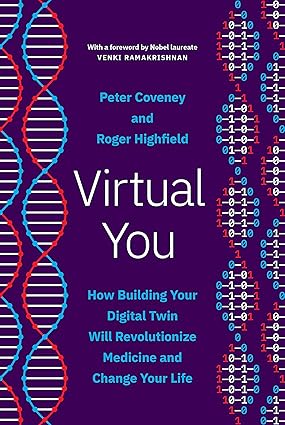
“Virtual You is the most comprehensive and comprehensible account so far of the way in which the revolution in computing and data is starting to transform human biology and medicine.”—Clive Cookson, Financial Times
“Transformative—a brilliant vision of how building your digital double might just save your life.”—Hannah Fry, author of Hello World
“Biotech is advancing fast; so is computer power. This book’s authors, well versed in both these fields, highlight the amazing potential of research that blends them together. Researchers are already constructing digital models of cells and organs and using them to do virtual experiments, without putting real people at risk. In a more futuristic vein, the authors speculate about the eventual goal of digitally twinning the most complex known entities in the universe—entire human beings. This engrossing book will broaden intellectual horizons—and deserves wide readership.”—Martin Rees, author of On the Future
“This stimulating and balanced book argues that biology is both a chemical and an informational science, and that building informational models will be critical for the future progress of biology and medicine. This clear, readable account from Peter Coveney and Roger Highfield shows how digital models not only inform us about how life works, but also how this knowledge can be used to transform how we treat human disease.”—Paul Nurse, Nobel Laureate and Director of the Francis Crick Institute
“Virtual You provides a dazzling guide to the frontiers of modern science—from the limits of mathematics, AI, and algorithms to the latest in genetics, deep learning, and quantum computing—to show how digital twins of people will herald a new era of medicine, one that is truly personalized and predictive.”—George Em Karniadakis, Brown University
“Virtual You gives a fascinating and accessible overview of the many global collaborative efforts to create a digital twin of a human being, and looks toward a future where the vision of P4 medicine—predictive, personalized, preventive, and participatory—has become a reality.”—Tony Hey, coauthor of The New Quantum Universe
“The human body is a collection of seven octillion atoms (seven followed by twenty-seven zeros), and if we could simulate their life dance in a computer, we could make predictions about our health. In this visionary book, Coveney and Highfield show how this dream may come true, revealing the science of complexity at its zenith. A must-read for anyone who is curious about the coming revolution in predictive medicine.”—Sauro Succi, Italian Institute of Technology
“This timely and highly informative book should be a thought provoker for a large and diverse readership, including the future research leaders and pioneers who will drive this field forward.”—Mark Girolami, University of Cambridge and The Alan Turing Institute
“Being able to use an individual’s medical and fitness tracker data to make ‘healthcasts’ is a game changer. I can’t wait to see my own virtual human come to digital life!”—Andrea Townsend-Nicholson, University College London
About the Author
Peter Coveney is director of the Centre for Computational Science at University College London, professor at the Informatics Institute, University of Amsterdam, and adjunct professor at the Yale School of Medicine. Roger Highfield is science director at the Science Museum Group, a member of the Medical Research Council, and visiting professor at University College London and the Dunn School, University of Oxford. They are the authors of Frontiers of Complexity and The Arrow of Time.



Reviews
There are no reviews yet.